
Bark Camp Meadow

In Ed Werler’s Book, The Call of Katahdin, he mentions a location called Bark Camp Meadow on the East Branch of the Penobscot River.
The year was 1947 and Ed, along with his wife Mary Jane and two dogs, had agreed to spend that fire season as Warden at the Daicey Mountain Fire Lookout. There was a warden’s cabin about halfway up the mountain where they would be living for several months and they needed to get their food and household gear “wangan”* up the East Branch of the Penobscot River from Grindstone, where the East Branch met the road, to the trail at the foot of the mountain leading to the warden’s and the fire cabins. This was a distance of about 16 miles upriver.
They met their riverman “Bink” and loaded their “wangan” and headed up river in a 20 foot Old Town canoe. They spent the first night at Whetstone cabin and the next day arrived at a place that Bink called Bark Camp Meadow. It is a shallow meadow, about 150 acres, on the west side of the East Branch and can be easily accessed from the main river. According to Ed: “Bink told us that years ago this had been the site of a woods camp where Hemlock logs were stripped before the bark was hauled to tanning factories down river, where the bark’s tannin was crucial to the tanning process”.

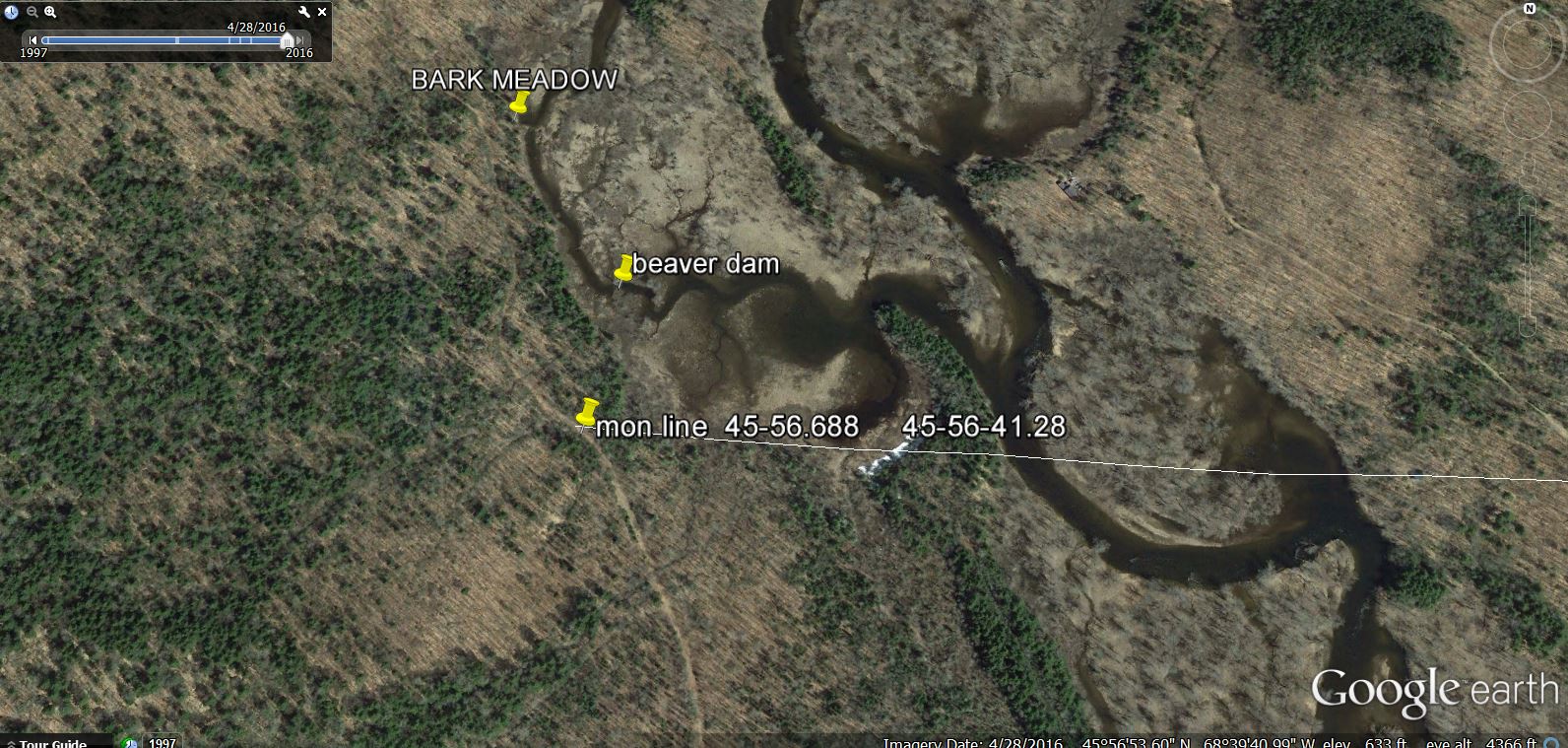
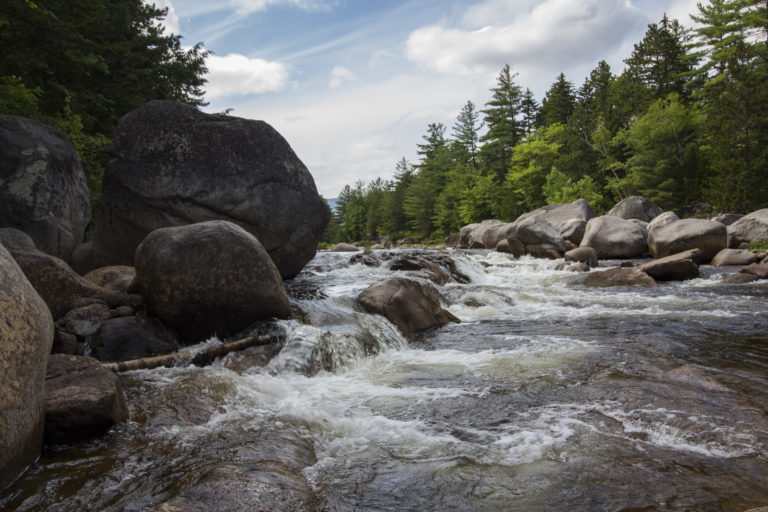
The East Branch of the river showing the Bark Meadow landing and the tote road.
Here there was a small shack six or eight foot square with a tin sign on the door PREVENT FOREST FIRES – MFS. This would be their storage building. There was a tote road along the river at this landing leading to the trail to the warden’s camp a short distance South.

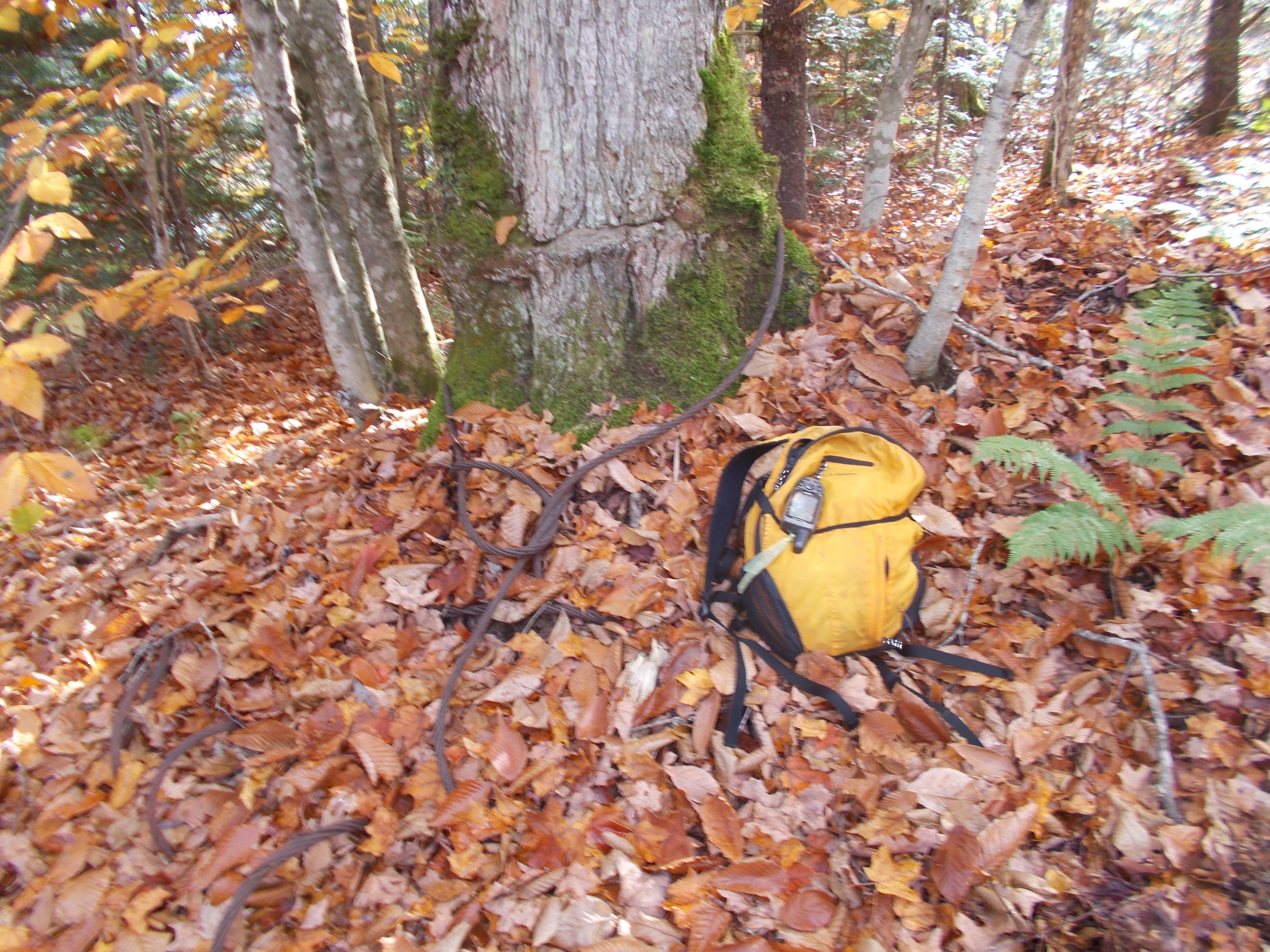
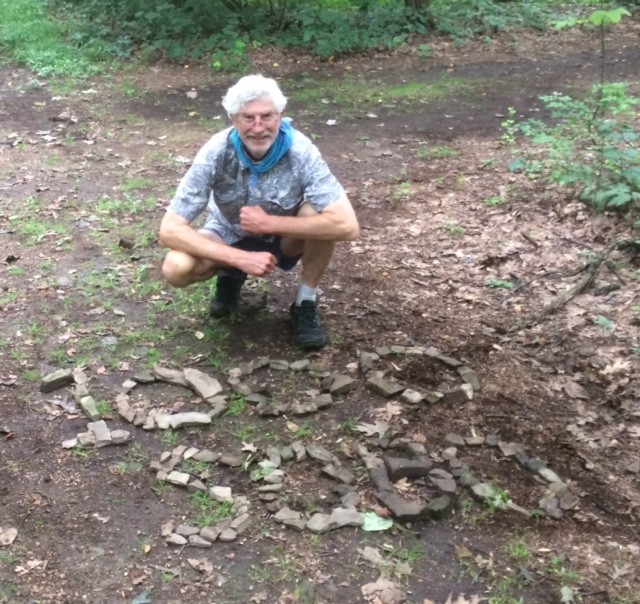
This photo is on the meadow side of the tote road at the former location of the storage building. There is no evidence of the storage building today. Note the logging cable that has grown into the tree.

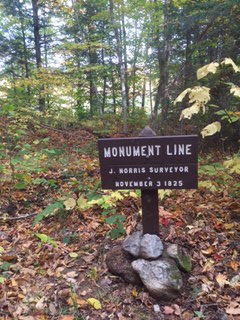
The Monument Line sign on the tote road just south of Bark Camp Meadow
Why the name, Bark Camp Meadow?
Tanning was a very large industry all over the Northeast, wherever there was a plentiful supply of Eastern Hemlock (Tsuga canadensis). Between 1840 and 1880, it was one of the leading industries in the State of Maine and by 1880 it was the number two industry in Maine, with hides being sent to Maine from all over the world even from such distant places as China and Australia.
At one time, the largest tannery in the United States was in Winn, Maine and the most northerly was in Bridgewater, Maine. This probably was because of the scarcity of Hemlock north of this area.
Extensive areas of Hemlock were cut, the bark stripped and the logs were left to rot in the woods.
There were huge mounds of bark left in the woods that did not rot. Unlike in the South, where slash left from logging rots in a very short time, our cold climate in the Northeast preserves the bark. There were still piles of bark covered with moss in the woods in the early 1950’s.
The process of peeling, yarding and hauling the bark to the factories is described in Appendix I of A History of Tanning in the State of Maine by Archibald Riley. This report was for a Masters Degree in Economics, but the Appendix is entirely about woods work and how the men lived in temporary shelters during the peeling season from the full moon in May to the full moon in August. All work was done in warm weather using temporary rough board camps or tents. This operation did not require the permanent buildings needed for logging in the winter in Maine.
The May to August time period is very important, because it is when the trees are growing very rapidly, creating new wood which is soft and slippery under the bark. Later in the season the layer has dried and tightened, making it much more difficult to peel the bark.
The cook was the most important person in the crew. He prepared four meals per day, breakfast and supper at the camp and two lunches in the woods. The cook did all the cooking and baked bread and pies for breakfast for the men. His “cookies” assistants did all the other chores, providing wood and water, cleaning up and delivering the lunches to the men who were working in the woods.**
The crews worked 11 hours a day beginning at five AM and ending at 6 PM with a one hour lunch break in the morning and afternoon.
A crew consisted of four men: a chopper, a knotter, a ring and splitter and a spudder.
With an axe, a ring was cut round the base of the tree and another ring four feet up. Then the bark was split down one side with an axe from ring to ring. A spudder inserted his spud into the split and forced the bark from the tree. A spud is a tool like a very large carpenter’s chisel, curved at the end to fit the shape of the log, with a handle some two to five feet in length. After the bark was forced from the tree, the chopper then felled the tree and the knotter trimmed the branches. The crew then continued ringing and splitting in four foot lengths and the spudder followed. The bark was put up in small piles near the felled tree and collected into larger piles along roads for loading on sleds drawn by teams of horses, for hauling to the tannery. Bark hauling began as soon as there was snow enough to make good sledding. Two cords of bark was about the average load with two horses in fair sledding. A bark hauler, that is, a man and team of two horses, ordinarily received from thirty five to forty dollars a month and board. In 1935, when the Riley report was written, wages for the men averaged about $20 dollars per month and board.
The felling and barking of Hemlock trees was rendered obsolete by the development of chemical processes for tanning hides. The tanning industry, once so prevalent in Maine, has largely disappeared from the state. Bark Camp Meadow still remains!
*wangan is a broad term by used by woodsmen and is taken from the Abenaki. In this case food, household gear, tools and necessities.
**The last project that was done in Maine where the workers lived and worked in the woods for months at a time with a cook and cookie was undertaken by the James W. Sewall Company of Old Town on the Allagash Wilderness Waterway 50 years ago. Felix Cote was the cook and he had worked for the Sewall Company part time for many years. His son in law Joe Sapiel was his cookie. They started with a survey crew at Telos Lake in June. The survey was completed in October at the town of Allagash more than eighty miles from Telos.
Earl Raymond is a Board Member of The International Appalachian Trail and a VIP for KWWNM.

Sail Away

Follow IAT Hiker, Sail Away, on her blog
But if we are about trails, and where I will be this summer/fall/hopefully-not-blizzards, check out the Pinhoti (AL-GA) to the Benton Mackaye Trail (GA) to the glorious and official Appalachian Trail. From now until I decide to stop, I will be gallivanting about madly, doing science (SCIENCE!) and in all other ways making a nuisance of myself in formerly respectable neighborhoods. So it goes.
The plan is to halt this winter and convalesce in Maine (and perhaps more science), then continue hiking into international lands in the spring of 2018, then perhaps sail across the ocean, then perhaps continue hiking. It shall be grand. You. I. Us, all together wonderful.
Send me letters, or food, or come join me in person!
Peace, Sail Away

The IAT in Québec: Where the Mountains Reach the Sea

International Appalachian Trail at a Glance:
Length: 650 kilometers (404 miles) Location: Canada, Province of Québec, Gaspé Peninsula Trail Type: Thru-hike with many options for day hikes and section hikes, divided in three territories
The Valley (115 miles) The trail goes through some forests and farmland, the first few days sees some steep climbs and a couple of river fords, but it smooths out afterwards.The Chic-Chocs (156 miles) The trail follows the peaks of the Chic-Chocs and McGerrigle mountain ranges. Very remote and rugged section, especially in Matane Wildlife Reserve. Some of the best views are in Gaspésie National Park with summits above treeline.The Coast (134 miles) The trail goes from village to village along the St-Lawrence river. This section is generally easier, but it still climbs from time to time in the mountains near the coast.
Navigation: Official guidebooks and maps can be found on the IAT website

From the Trail… Sharing Space

Trails are often designed and built for a specific purpose. The first 50 or so miles along the IAT, heading south from the border crossing, has become a multi-use trail, but not by any grand design or plan.

Continue reading

Big Hikes on the IAT

The questions about hiking the IAT started coming early in the fall of 2016; questions about transportation, trail conditions in Maine, contacts for hiker information in Canada, and all the routes around the North Atlantic.

Denali, Don Hudson, Wuss
No one had proposed to walk the entire International Appalachian Trail, from the southeastern geographical high point of Flagg Mountain, Alabama, to the town of Taroudant, Morocco before Anne Conover reached out to us to learn more about the trail. Originally from Texas, Anne was teaching science in South Dakota when the IAT came across her screen. Something in the description of the trail, its origin and geologic underpinnings, and outlandish vision caught her attention. During one back and forth between Dick Anderson and Don Hudson, while discussing Anne’s plans to include some tall ship sailing to make connections between the trail in North America and the trail in Europe, the trail name of ‘Sail Away’ for Anne popped into Don’s head, and Anne accepted it enthusiastically. Plans were hatched to begin hiking north from Flagg Mountain as soon as possible after the end of the school year.

Scout
Barney ‘Scout’ Mann reached out to the Appalachian Trail Conservancy in the late winter with a request for help in promoting his new book about the Pacific Crest Trail (PCT). Barney was planning a southbound hike on the Maine section of the IAT as well as the AT, and he proposed a presentation and book signing for "someplace in Portland, Maine" in late May, just before heading out on his walk. Hawk Metheny at the northeast office of the AT in western Massachusetts put Barney in touch with Dick and Don, and they quickly added Seth Levy to the ad hoc committee charged with finding a venue for the book PCT.
Faith ‘Wuss’ McClure got in touch with Carol Gay in the IAT office in December with questions about the IAT in Maine and the connection to the AT through Baxter State Park. Faith had never done anything like this before, but she was planning to do a southbound hike of the Eastern Continental Trail from the Maine/New Brunswick border to her home state of Florida. Faith’s questions came just at the time that the Baxter State Park Authority closed the Katahdin Lake East gate used by the IAT to get from the new national monument into Avalanche Field in Baxter. We hemmed and hawed, and promised Faith that we’d have answers for her by the time in late May that she intended to start walking south.
Later in the winter, we first heard from Mary ‘Denali McKinley who was planning to walk the IAT from Maine to Cap Gaspé, Quebec during her free summer (Mary is a math prof) as part of her section-hike of the entire Eastern Continental Trail. Mary had already walked all but the southern-most 100 miles of the ECT in Florida between Florida and Maine, and she was ready to begin to put the IAT behind her. Just as with Barney and Faith, our exchanges focused on how to get from the trail into Baxter now that the longstanding route past Katahdin Lake was temporarily blocked.
As this newsletter goes to press, we can report that all of these great hikes are on track or have been successfully completed.

Sail Away
Sail Away is well on her way north, having taken a well-deserved day off to visit in farm in Asheville, North Carolina. Her brother walked with her for the first stretch, and now she’s heading north on the AT. She’ll make her way to the White Mountains of New Hampshire this fall, and stop for the winter season to earn some money and continue to plan for the trail ahead. The current plan is to complete the entire trail in four years — a challenging and inspiring goal. You can follow Sail Away’s progress at her blog – https://iatsailaway.wordpress.com.
By now, Scout, is likely walking in Maryland or West Virginia, on his way to Springer Mountain and the end of his summer’s walk on October 20th. You can follow him here – http://www.trailjournals.com/mann3. Scout makes a point to provide up to date information about trail conditions in his blog entries, and his early entries about the IAT in Maine are no exception. This kind of reporting is essential for those of us who maintain the trail.
One of the joys of working on the IAT in Maine is the opportunity to interact with the hiking community, a rich and varied collection of individuals. Half of the group presented here are southbounders (SOBOs) on the IAT. Cheryl and Kirk St. Peter stepped right up to job of ‘Trail Angels’ and helped Scout and Wuss, as well as ‘RT’ — a third SOBO who showed up serendipitously as Cheryl and Kirk were dropping off Scout in Fort Fairfield. Cheryl’s note of a few days later says it all:
5/31 – From Cheryl
Hi Scout!
First, so sorry about the tick! Really, Kirk didn’t think we had any this far north, since we’ve never encountered any or heard of anyone encountering any (until now). Also, sorry about the bogs – glad you found that a highlight. We actually followed the ATV path when it veered off the border trail when we hiked in 2010.
Second, the road walk from Shin Pond to Matagamon is not a typical road walk, since it’s all through the woods with no houses – very pleasant, actually. FYI, a really nice place to take a break is at Hay Lake; it’s worth a stop.
Third, we’ve been reading both journal entries – yours and RT’s – great entries and photos – thanks!
Attached is the story that I finally had a chance to write up for our website. Let me know if you see anything you’d like to change before we post it.
Good luck with the rest of your hike!
Cheryl (& Kirk)
P.S. Did you ever meet up with Faith “Wuss” McClure at Brookside? I wonder how she’s doing?

What about Wuss?!
When Mary ‘Denali’ McKinley got in touch to tell us that she was arriving in Portland on June 9th, Dick and Don decided to meet with her before she headed out on the trail. The connections by bus from Portland to Millinocket consume most of a day, so Don offered to drop Denali at the Mile #12 starting point of the IAT in Katahdin Woods & Waters National Monument the next day. As Don and Denali arrived at the drop-off point on the Loop Road in the monument, out of the woods walked Wuss. After dropping Denali’s pack in the Katahdin Brook lean-to, Don dropped her at the old Katahdin Lake East path before ferrying Wuss to the AT Lodge in Millinocket.
As Denali headed north, Wuss headed south. When Don reported to Denali in late July that Wuss had taken a well-deserved week off to rest her knees, she proposed that we change Wuss’s trail name to No Wuss. And, it’s done! While Denali wrapped up her hike at Cap Gaspé on August 13th, No Wuss was heading into Massachusetts on her way south. No Wuss has elected to by pass the Mahoosucs and the White Mountains until her legs are stronger and her knees more resilient.
The stories of long distance hikers put trails such as the IAT on the map. We have no idea how many people have walked the IAT in Maine or the complete trail in Canada, yet we are confident that the story of John Brinda’s walk in 1997 inspired Nimblewill Nomad — Eb Eberhart — to walk from Key West to Belle Isle.
The four stories shared here are just a handful of stories from the IAT this summer, and they will no doubt inspire others to get out on the trail in the coming months and years.
A walk in the woods is never truly a solitary experience!

Orin Falls Hike with Aislinn Sarnacki

Aislinn Sarnacki of the Bangor Daily News will take you on a 1-minue hike of Orin Falls in Katahdin Woods and Waters National Monument.
Click Here to go to the full story on the Bangor Daily News website and watch the video.
About Aislinn Sarnacki
Aislinn is a Bangor Daily News reporter for the Outdoors pages, focusing on outdoor recreation and Maine wildlife. Visit her main blog at actoutwithaislinn.bangordailynews.com.

IAT Attends 2017 ATC Biennial

(L-R) Dick Anderson, Earl Raymond, Don Hudson and Paul Wylezol at the IAT booth
The Appalachian Trail Conservancy held workshop and business component of its AT Vista conference at Colby College in Waterville, Maine, between Friday, August 4th and Sunday August 5th.
The International Appalachian Trail was well-represented by the North American contingent, including Maine Chapter Board Members Dick Anderson, Don Hudson, Earl Raymond, and Herb Hartman.
IAT Maine Board Member Cliff young wears two hats; Cliff spent a busy weekend as a conference volunteer for the Maine Appalachian Trail Club. The connections between MATC and IAT Maine are growing annually in large part owing to Cliff’s participation with both groups.
The IAT workshops were well attended, beginning with a presentation by Poul Jorgensen of IAT New Brunswick and Sentier NB Trails, which included a very nice glimpse of the new southern route for the IAT — from Perth Andover to St. John, and on to southeastern New Brunswick and the links to PEI and Nova Scotia. The IAT is a bit like the Silk Road, as it is in fact a network of trails that lead from Maine through Atlantic Canada to the North American terminus at Crow Head, overlooking the United Nations World Heritage site at L’anse aux Meadows. IAT International Council co-chair Paul Wylezol followed up with an overview of IAT development across Europe, as well as an in-depth introduction to the Global Geopark system, now a UNESCO program on par with Man and the Biosphere and the World Heritage program. Paul focused on ‘Drifting Apart’, the EU-funded collaboration of Geoparks around the North Atlantic Ocean Basin, which were inspired — he suspects — by the organizing geologic principles of the IAT. There are now two Canadian partners in Drifting Apart, including Stonehammer Geopark in southwestern new Brunswick and the Cabox aspiring Geopark, named for the highest point in Newfoundland and centered on the Humber Valley and the very special tectonic history of that region. The stunning photography — is there ever a cloudy day in the Humber Valley?!! — jad a lot of people buzzing about making a trip to walk in Newfoundland. Central to IAT Newfoundland’s focus this year, and for the coming several years, is the celebration of James Cook’s explorations and mapmaking, which began in earnest in western Newfoundland 250 years ago. Look for Cook 250 reports throughout the remainder of this year in particular, as the IAT in Newfoundland winds right along the dramatic coastline where Cook cut his teeth as a chart maker for the British Admiralty.
The afternoon workshop focused on the IAT in the new Katahdin Woods and Waters National Monument. Dick Anderson opened with the history of IAT Maine’s relationship with landowner Roxanne Quimby in 2004, and the succession of land acquisition, trail, and campsite building that brings us to the present time. Don Hudson and Earl Raymond then filled out Dick’s outline, and left the audience with a good understanding of how IAT Maine Board Members helped to explore and interpret the rich human and natural history of the East Branch lands in advance of the gift by Roxanne of 89,000 acres to the nation, and President Obama’s official designation of the monument on August 24, 2016. Some concern about the status of the monument under the review of current Department of Interior Secretary Zinke surfaced. Don shared his confidence in the process, and his expectation that though some specific recommendations may result for Zinke’s review, such as the development of a model, working forest for a 13,000 acre parcel in the northeast corner of the monument, the overall status will remain unchanged. In fact, Secretary Zinke stated flatly that the best outcome might be for the monument to move as quickly as possible to National Park status. Readers of this space should stay tuned! Just as the morning session created a bit of a buzz about exploring Atlantic Canada, the afternoon session left participants wanting to have a closer look at places such as Stair Falls, Thoreau’s Checkerberry Campsite, or the Old Keep Path, which was surveyed shortly after statehood on order by the Maine Legislature to flesh out the route for a wagon road from the east to the top of Katahdin — not to be out done by the Mt. Washington Road.
The business and workshop component of the conference concluded largely Sunday evening, including the traditional reception for long distance thru-hikers, hosted this year by the Appalachian Long Distance Hikers Association and the IAT. Dick lead off the reception with high praise of retired ATC Executive Director David Startzell. Dick said of Dave, "[here add some quotes directly from Dick’s speech — Dick, send a copy of your speech to Carol, please!]. Paul and Don then presented Dave with a framed certificate as one of IAT Maine’s first class of Honorary Directors. Dave joins Governor Joe Brennan, founding treasurer Bill Nichols, and the indomitable Torrey Sylvester, who almost single-handedly acquired 8 of our 9 lean-tos as outrigh donations from Katahdin Log Homes. This first group of Honorary Directors is an exemplary band of friends and champions of the trail.
Conference goers will stay in the Waterville area through August 11th to enjoy field trips and a variety of half- and day-long workshops on a range of aspects of trail building and maintenance, as well as search and rescue and other aspects of organizational responsibility and leadership.
The 2020 AT Vista Conference will be at Ramapo College in New Jersey, and the IAT will be there!

MCIAT Annual Meeting

The 23rd Annual Meeting of the Maine Chapter of the International Appalachian Trail was held May 18, 19, and 20 at Shin Pond Village and Mt. Chase Lodge.
One of the principle objectives of the meeting was to certify our trail crew volunteers for work on the new Katahdin Woods and Waters National Monument. A special chainsaw certification workshop was held Thursday morning and afternoon, leading up to our traditional gathering at the Patten Lumberman’s Museum. The Curator of the museum, Rhonda Brophy welcomed us with an update of work, and especially on the significant impact that the designation of the national monument has had on visitation. Following the designation in late August 2016, the number of visitors to the museum has doubled.
Thursday night’s dinner at Shin Pond Village was followed by a presentation by author Catherine Schmidt on her recently published book – The President’s Salmon: Restoring the King of Fish and its Home Waters. Catherine has chronicled the decline of the historic population of salmon in the Penobscot watershed, as well as the efforts by conservationists, the Penobscot Indian Nation, politicians, and scientists to restore the river to some semblance of its former health and vitality.
The Friday program included an important introduction to the leadership of the new national monument, and expectations for the support and work of volunteers, as well as a series of reports on topics ranging from current management projects in Baxter State Park, a new muscle-pwered, multi-use trail planned for the stretch of national monument and neighboring land from Grindstone Rapids to the Sebois River Gorge east of the East Branch of the Penobscot River. We heard about the efforts of current businesses to support the monument, as well as the status of the Matagamon Dam and the work of the Department of Marine Resources to restore salmon in East Branch.
A highlight of the late afternoon business meeting was the award to Torrey Sylvester, IAT Board Member since 1995, of Honorary Director. Among many other contributions, Torrey secured every one of the IAT lean-tos — 9 of the 10 through outright donations by log home building companies in Aroostook County. Torrey joins Joe Brennan and Bob Nichols as our first Honorary Directors.
Following a sumptuous dinner at Mt. Chase Lodge, Bart DeWolf spoke about the search for the location of historic dams — now long gone — along Wassataquoik Stream, as well as key fords of the stream used by early explorers of Katahdin and the region.
A small group of hikers joined Bob Marvinney for a good walk up Sugarloaf to view the historic geologic site described by Bob Neuman. Neuman’s identification of fossil brachiopods on Sugarloaf as a Europeans species identical to ones found in Ireland and Wales helped launch the theory of plate tectonics to its prominence, explaining the fundamental and dynamic Earth system.
Lastly, thanks to Walter Anderson for finding the speakers and coordinating another productive and enjoyable Annual Meeting.